Collagen Peptides: What the Evidence Actually Shows
Collagen peptides are one of the most purchased supplements in the connective tissue space. Here is what the peer reviewed literature actually measured, and why the delivery chemistry matters more than most buyers realize.

Collagen peptides now sit on more kitchen counters than creatine. That popularity is ahead of its evidence base in some respects and fairly well earned in others. The gap between what the marketing says and what the studies actually measured is worth understanding before you commit to 10 grams a day for six months.
What collagen peptides are, at the amino acid level
Collagen is the most abundant structural protein in the human body. It makes up the scaffold of tendons, ligaments, cartilage, bone, and the dermis. The collagen triple helix is built from repeating glycine proline hydroxyproline sequences. Those sequences are unusually rich in glycine and proline relative to other dietary proteins, which is exactly why the supplement matters: most protein sources do not supply those amino acids in anything close to that ratio.
Hydrolyzed collagen peptides are produced by enzymatic breakdown of whole collagen into shorter chains, typically 3 to 10 kilodaltons. The resulting peptide fragments are water soluble and, critically, survive gut transit in a form that appears in peripheral blood. A recurring finding in human pharmacokinetic studies is that certain dipeptides and tripeptides derived from collagen, particularly hydroxyproline glycine and proline hydroxyproline, are detectable in plasma within 60 minutes of ingestion. That bioavailability signal is what makes the supplement mechanistically plausible rather than merely a source of generic amino acids.
The amino acid angle also connects to a genuinely interesting problem in analytical chemistry. Researchers studying amino acid metabolism now use hyperpolarization techniques like SABRE (Signal Amplification by Reversible Exchange) to dramatically boost the sensitivity of NMR imaging for tracking low concentration metabolites such as glycine and valine in solution. That work, done in vitro on isotopically labeled amino acids, demonstrates that the field is developing the tools to watch individual amino acid fate in biological compartments at concentrations that were previously invisible. What that means practically is that future pharmacokinetic research on collagen derived peptides will be far more granular than anything available today. The current human studies measured plasma appearance; next generation work will map tissue destination.
Tendons and cartilage: where the evidence is strongest
The most rigorously studied application for hydrolyzed collagen is connective tissue support in the context of training. The mechanistic rationale is straightforward. Tendons and cartilage have low vascularity and slow turnover. They rely on fibroblast and chondrocyte activity to synthesize new collagen, and both cell types are responsive to the hydroxyproline containing peptides that appear in blood after collagen ingestion.
Shaw and colleagues published a controlled human trial showing that 15 grams of gelatin taken with 50 mg of vitamin C and consumed 60 minutes before a brief bout of jumping exercise resulted in roughly doubled circulating levels of procollagen type 1 N terminal peptide, a marker of collagen synthesis, compared to placebo. The jump protocol was intentional: mechanical loading appears to amplify the fibroblast response to the circulating peptides. Vitamin C is a required cofactor for prolyl hydroxylase, the enzyme that installs the hydroxyproline residues that give the collagen triple helix its stability. Without adequate vitamin C, the synthesis pathway stalls regardless of substrate availability.
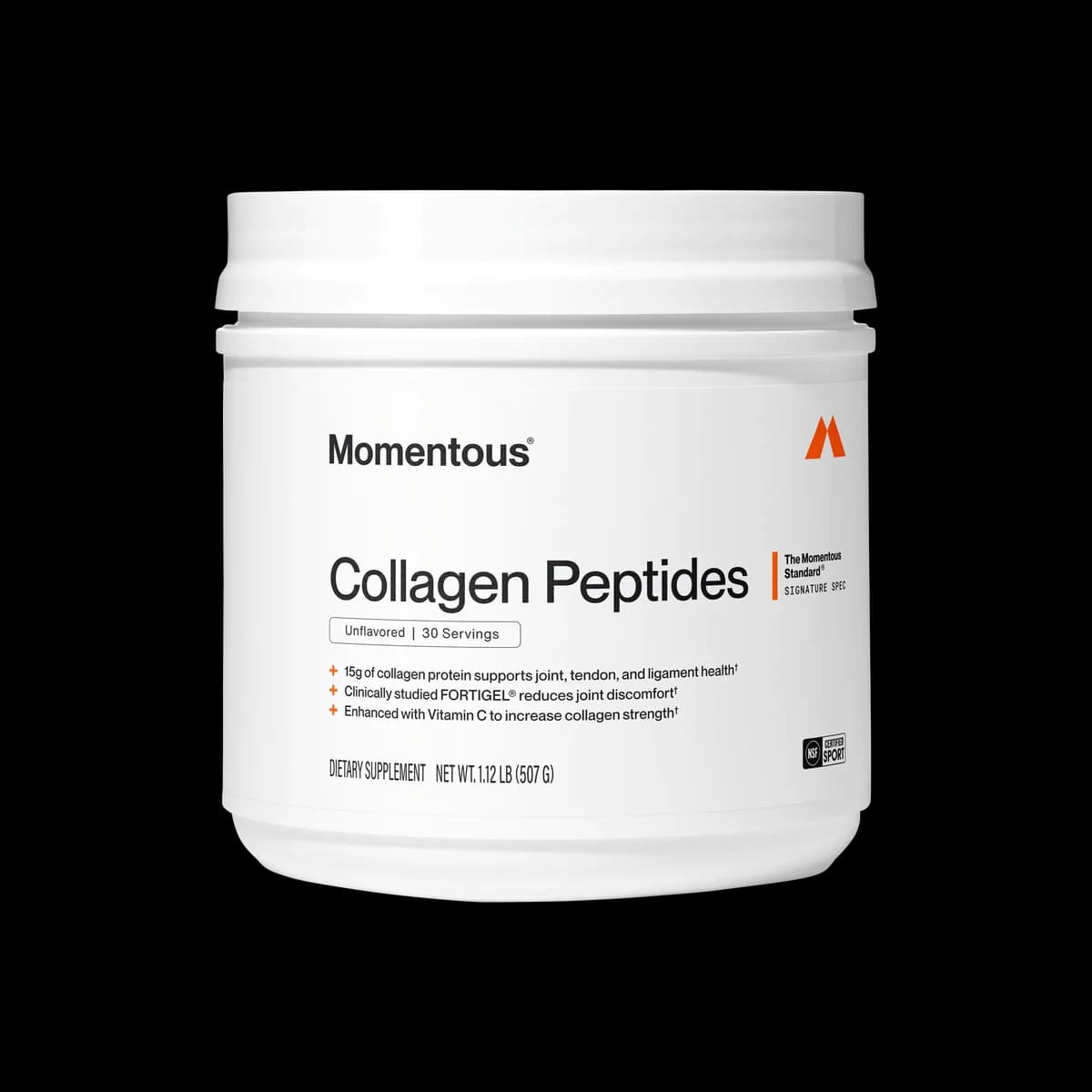
Specific trademarked bioactive collagen peptide blends have also accumulated controlled trial data. FORTIGEL has been studied in human trials measuring cartilage degradation markers and self reported joint comfort in active adults. TENDOFORTE has been evaluated in tendons specifically, with published human trial data on Achilles tendon cross sectional area and patient reported outcomes. These are not the same peptide profiles as a generic store brand collagen powder, and the difference in trial design (specific fraction, specific dose, specific population) is why we think brand and formulation specificity matters when interpreting this research.
Skin: real signal, modest effect sizes
Skin is the other area where human trial data exists. VERISOL, a specific bioactive peptide fraction, has been evaluated in double blind randomized controlled trials measuring skin elasticity and the depth of periorbital wrinkles by profilometry. A 2014 trial published in Skin Pharmacology and Physiology reported a statistically significant improvement in skin elasticity at 2.5 grams per day over eight weeks in women aged 35 to 55 compared to placebo. Procollagen type 1 levels also rose in the treatment group.
The honest read on the skin literature is that effects are real but modest, replication is limited to a small number of independent groups, and most trials use the manufacturer's own peptide fraction rather than a generic product. That does not make the results wrong, but it does mean the effect size numbers do not necessarily transfer to commodity collagen powders.
Why colloidal behavior in the gut matters more than the label suggests
One underappreciated variable in collagen peptide absorption is what happens in the aqueous environment of the small intestine before uptake occurs. Peptide fragments exist in suspension as colloidal particles, and their stability in that medium affects how efficiently they are presented to the intestinal brush border.
Soft matter chemistry research on excluded volume interactions in colloidal suspensions reveals a principle directly relevant here. Excluded volume effects, the steric forces that arise simply because two particles cannot occupy the same space, drive phase separation behavior in crowded aqueous environments. In the gut lumen, which is a highly crowded, heterogeneous colloidal medium full of mucin glycoproteins, bile salts, and dietary macromolecules, the local concentration and particle size distribution of peptide aggregates will influence whether they remain in a dispersed, absorbable state or partition into a less accessible phase. This is not speculation unique to collagen: it is the same physics that governs why some liposomal and micellar delivery vehicles outperform their unformulated counterparts. The colloidal state of the peptide at the moment of mucosal contact is part of the bioavailability equation, not just the amino acid sequence itself.
This is also why the common advice to simply "take more collagen" to compensate for a cheaper product is likely an oversimplification. If a lower quality hydrolysate has a broader and less consistent molecular weight distribution, its colloidal behavior in the gut will differ from a tightly fractionated bioactive peptide preparation, potentially reducing the proportion that reaches the portal circulation in bioactive form.
What the literature does not yet support
Collagen peptides are often marketed for muscle mass, bone density, and a broad range of longevity outcomes. The muscle mass claim is the weakest. Collagen is not a complete protein for muscle protein synthesis purposes: it is low in leucine, the key amino acid for activating the mTORC1 pathway that drives muscle anabolism. Trials comparing collagen to whey at matched protein doses consistently show whey driving greater muscle protein synthesis rates. A position in the literature does exist for collagen as a complement to resistance training in older adults with sarcopenia, but that finding relates to functional outcomes in a specific population and does not transfer cleanly to a general muscle building context.
Bone density data in humans is promising but thin. The mechanisms are plausible (collagen makes up roughly 30 percent of bone dry weight and osteoblasts express receptors for collagen derived peptides) but robust long term human trials with dual energy X ray absorptiometry as the primary endpoint remain limited.
Dosing: what the trials actually used
The dose ranges across published human trials cluster around 2.5 to 15 grams per day depending on the outcome measured. Skin trials have used as little as 2.5 grams of a specific bioactive fraction. Joint and tendon trials have generally used 5 to 15 grams, with the Shaw gelatin protocol specifically at 15 grams paired with vitamin C and timed to precede mechanical loading by one hour. The timing and cofactor context matter. Taking collagen at rest, without vitamin C, and at a low dose borrowed from a skin trial is not the same protocol that produced the tendon data.
We also note that the longevity biology angle, specifically the possibility that collagen synthesis capacity declines with age and that restoring substrate availability could offset some of that decline, is mechanistically coherent but not yet supported by long term human outcome trials. Research into how cells take up and integrate exogenous structural building blocks is active across multiple fields, including emerging work on improving intracellular delivery of biological cargo in aging biology. The principle that delivery vehicle engineering changes biological outcomes is well established. Whether that principle will eventually refine collagen peptide formulations the way it has refined other compound classes remains an open question.
Where this leaves us
Collagen peptides have a legitimate evidence base for connective tissue support, particularly tendons and skin, when the right fraction is used at the right dose with appropriate cofactors and in the context of mechanical loading. The bioavailability of specific peptide fractions is real and measurable. The gap between branded bioactive peptide fractions with trial data and generic commodity powders is meaningful and largely ignored by the market. The muscle building claim is the most overstated. The analytical tools to fully map what happens to collagen peptides between ingestion and tissue incorporation are only now coming into view. The question the field still owes an answer to is whether the effect sizes seen in four to eight week skin and joint trials hold over years of consistent use, and whether those effects translate uniformly across age groups and baseline collagen status.
For informational purposes only. These statements have not been evaluated by the FDA. Not intended to diagnose, treat, cure, or prevent any disease. Consult a qualified healthcare professional before starting any supplement, especially if pregnant, nursing, or taking medication.
Products Mentioned
Products from the Paragon catalog related to the topic discussed above.