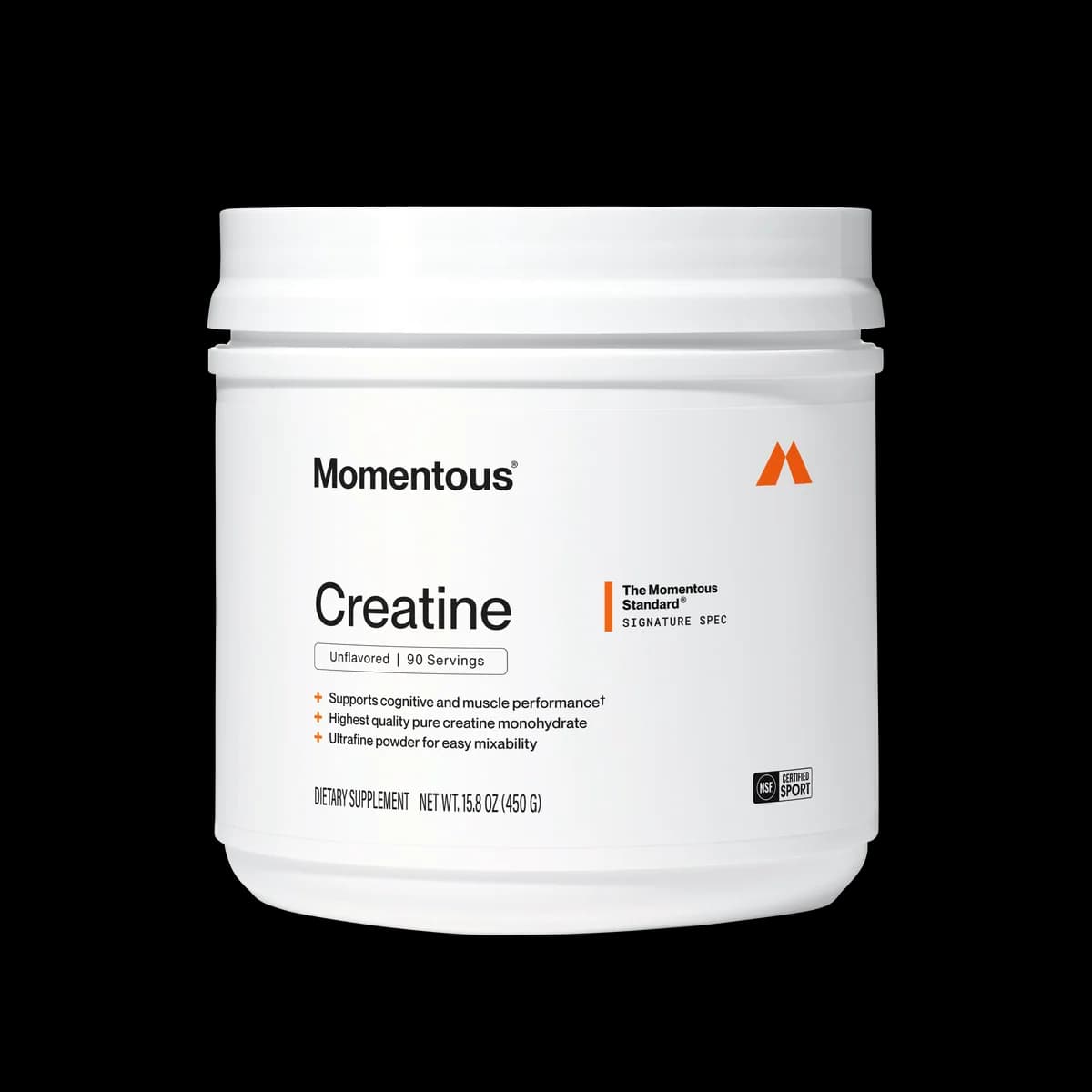
Creatine Monohydrate: What the 2025 Data Reveals
A 2025 meta analysis on postmenopausal women and a mouse model dissecting creatine's metabolic role in the brain together reframe what creatine monohydrate actually does beyond the weight room. Here is what the primary literature measured.

Creatine monohydrate is the most studied performance supplement in the literature. The 2023 ISSN position stand catalogued over 685 human trials. And yet two papers published in 2025 quietly push the conversation into territory most creatine buyers are not tracking: bone density in postmenopausal women and a neurometabolic pathway that matters far beyond athletic populations. Read together, they suggest that creatine's story is considerably wider than its reputation as something you mix into a pre workout.
What creatine monohydrate actually does at the cell level
Creatine phosphate donates a phosphate group to ADP, regenerating ATP during short bursts of high intensity effort. That is the textbook mechanism, and it is accurate as far as it goes. But the phosphocreatine system is not confined to skeletal muscle. The brain is an energetically expensive organ, consuming roughly 20 percent of resting metabolic output in a structure that represents about 2 percent of body mass. Neurons rely on the same ATP regeneration chemistry, and dietary creatine crosses the blood brain barrier, raising intracellular creatine concentrations in neural tissue.
The enzymatic pathway that makes creatine endogenously involves two steps: arginine glycine amidinotransferase (AGAT) converts arginine and glycine into guanidinoacetate, and guanidinoacetoacetate methyltransferase (GAMT) then methylates guanidinoacetate into creatine. When GAMT is deficient, guanidinoacetate accumulates and becomes neurotoxic. A 2025 mouse model study published in the Journal of Inherited Metabolic Disease found that oral creatine supplementation in GAMT deficient mice suppressed AGAT expression via a feedback mechanism, directly reducing guanidinoacetate buildup. The mice receiving creatine showed measurably lower circulating guanidinoacetate compared to untreated controls. This is an animal model finding, not a human clinical trial, and GAMT deficiency is a rare inherited condition. But the mechanistic signal matters: it demonstrates that exogenous creatine can modulate the upstream enzymatic machinery of its own synthesis pathway, not just serve as a passive phosphate donor.
That regulatory feedback loop is the kind of finding that changes how we think about creatine in populations where endogenous synthesis may be suboptimal, including older adults, vegetarians, and people under sustained cognitive demand.
The postmenopausal bone density signal
Most creatine buyers think about lean mass. The muscle data is strong and well replicated. What is less discussed is what creatine supplementation does to bone, particularly in women after menopause, when estrogen withdrawal accelerates bone resorption and the risk of fracture climbs sharply.
A 2025 systematic review and meta analysis published in the Journal of the International Society of Sports Nutrition pooled available randomized controlled trial data on creatine monohydrate supplementation in postmenopausal women, examining lean mass, strength, and bone mineral density as primary outcomes. The human trial data showed that creatine supplementation, when paired with resistance training, produced statistically significant improvements in lean mass and upper body strength compared to placebo. The bone density findings were more nuanced: creatine appeared to attenuate bone loss rather than dramatically reverse it, with the effect dependent on whether resistance training was co administered. Creatine alone without mechanical loading did not produce the same skeletal signal.
That qualifier is important. Bone is a mechanosensitive tissue. Osteoblasts respond to physical strain, and creatine's likely contribution is partly indirect: by enabling harder training sessions (more reps, more load, more mechanical stimulus to the skeleton), it amplifies the osteogenic signal that resistance exercise already provides. The meta analysis authors noted this synergy explicitly, which is consistent with what the mechanobiology literature has long argued about bone adaptation. The practical implication is that creatine is not a substitute for resistance training in this population. It is a way to make that training more productive.
The quantum battery analogy: why catalytic stabilization matters in biology
At first glance, a physics paper on energy storage in quantum systems has nothing to do with creatine. But the conceptual architecture is worth following. Research on quantum battery systems examined what happens when an auxiliary catalytic element is introduced between a charger and an energy storing array. Without the catalyst, energy transfer was noisy: pronounced oscillations, backflow, and poor retention. With a properly coupled catalytic intermediary, those oscillations were suppressed and net energy delivery to the storage array improved substantially. The catalyst did not add energy to the system. It stabilized the transfer pathway so that energy already flowing from the charger arrived at its destination more efficiently.
Creatine's role in cellular bioenergetics follows an analogous logic. The phosphocreatine system does not generate ATP from nothing. It acts as a temporal buffer and spatial shuttle, accepting phosphate from mitochondria during rest and donating it rapidly to sites of ATP demand during effort. In neurons and muscle fibers where ATP turnover spikes transiently and local diffusion limitations would otherwise create energy deficits, the creatine shuttle suppresses those metabolic oscillations and keeps energy supply stable at the point of demand. The cell biology here is not quantum, but the engineering principle is the same: a well positioned intermediary that stabilizes energy delivery without itself being the primary energy source. That framing also explains why creatine's benefits are most apparent in high frequency, high demand contexts, intense training, sustained cognitive load, sleep deprivation, and not in low demand baseline conditions.
Form and dose: what the trials actually used
Creatine monohydrate remains the form with the broadest human trial evidence base. Creatine HCl and kre alkalyn have been marketed as superior because of their solubility and pH stability, but controlled head to head trials have not demonstrated superior outcomes at matched creatine equivalent doses. The postmenopausal meta analysis used monohydrate across its included trials. The GAMT mouse model used monohydrate. The loading protocol used in most foundational human trials (20 grams per day in four divided doses for five to seven days, followed by 3 to 5 grams per day maintenance) saturates muscle creatine stores roughly twice as fast as a low dose approach but produces the same end state given several weeks at maintenance dose. Loading is a choice about speed, not outcome.
For the postmenopausal population specifically, the trials pooled in the 2025 meta analysis generally used 3 to 5 grams per day without a loading phase. That dose range is consistent with what is needed to meaningfully elevate muscle creatine content in older adults over several weeks of supplementation paired with resistance training two to three times per week.
Where the evidence base still has gaps
The neurometabolic data on creatine is almost entirely preclinical. The GAMT mouse model finding on guanidinoacetate suppression is a controlled in vivo demonstration of a regulatory mechanism, but translating that to human populations without GAMT deficiency requires caution. Healthy adults already regulate their own creatine synthesis feedback competently, and the dramatic effect seen in a genetic knockout model does not predict an equivalent effect in people with intact enzyme function. What the mouse model does is illuminate the pathway, not prescribe an intervention for healthy people.
The bone density data in postmenopausal women is promising but still thin by the standards of long term fracture outcome trials. Surrogate markers like dual energy X ray absorptiometry scans are meaningful, but the meta analysis itself noted that the number of available high quality trials in this population remains limited. This is an area where the mechanistic rationale is strong and early human data is encouraging, not an area where the case is closed.
The question the field still owes an answer to is whether consistent creatine supplementation across the decade surrounding menopause produces measurable differences in long term skeletal outcomes in women who are also engaging in regular resistance training. That trial has not been run at adequate scale.
For informational purposes only. These statements have not been evaluated by the FDA. Not intended to diagnose, treat, cure, or prevent any disease. Consult a qualified healthcare professional before starting any supplement, especially if pregnant, nursing, or taking medication.
Products Mentioned
Products from the Paragon catalog related to the topic discussed above.