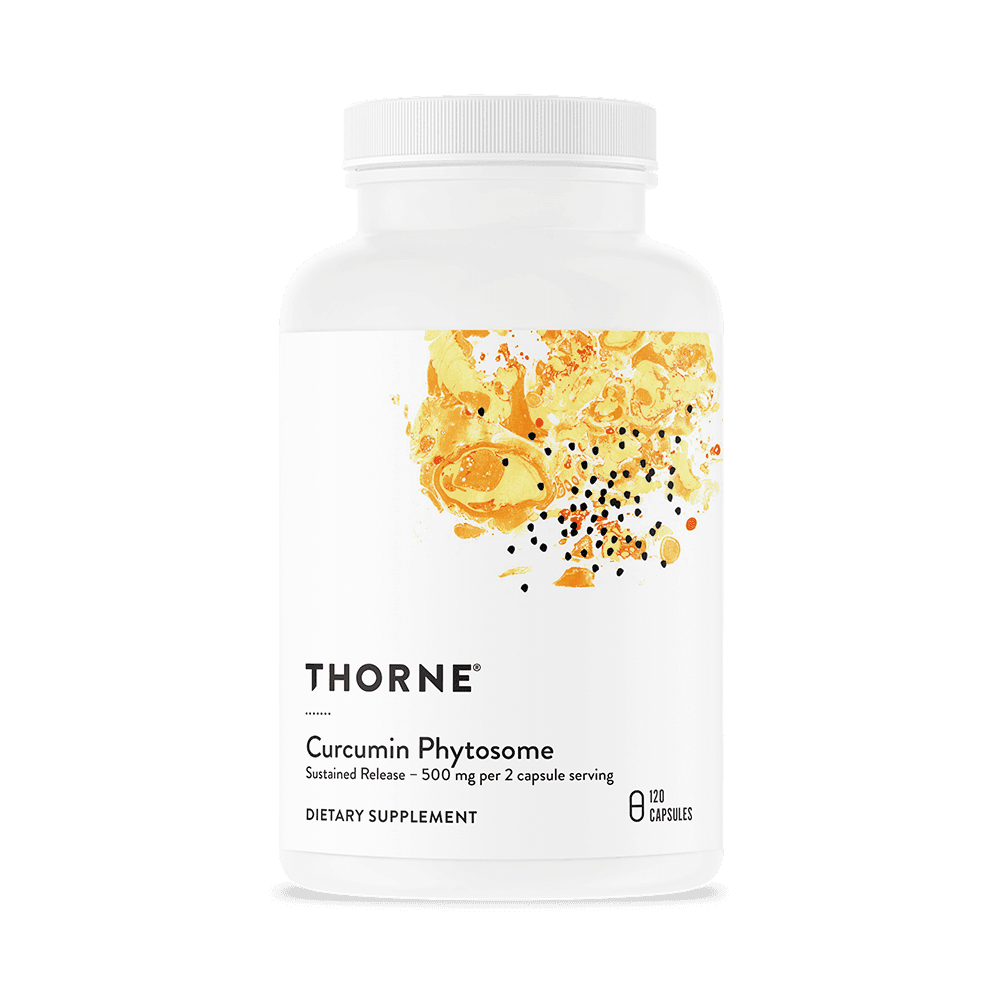
Curcumin Phytosome: Bioavailability and Inflammation
Curcumin's inflammation research is compelling. Its bioavailability is the problem. Here is what the phytosomal delivery approach actually solves, and what the primary literature measured.

Curcumin has one of the most studied inflammatory mechanism profiles in the supplement literature. It also has one of the worst raw bioavailability profiles of any compound in that same category. Those two facts sit in permanent tension, and understanding why phytosomal delivery was developed as a solution requires understanding both ends of that tension at once.
What curcumin actually does at the molecular level
Curcumin is a polyphenolic compound extracted from the rhizome of Curcuma longa. Its primary mechanistic interest lies in how it interacts with several inflammatory signaling nodes. It modulates NF-kB, a transcription factor that sits upstream of a wide range of inflammatory cytokine cascades including tumor necrosis factor alpha and interleukin 6. It also interacts with COX 2 enzyme expression and with Nrf2, a master regulator of antioxidant response genes. None of those interactions is exotic. What is notable is that curcumin appears to engage multiple points in the same signaling network rather than hitting a single target.
The problem is getting enough of it to matter in human tissue. Curcumin is lipophilic, meaning it repels water and aggregates poorly in the aqueous environment of the gut. It is also rapidly metabolized in the intestinal wall and liver before it reaches systemic circulation. Studies in humans consuming standard curcumin extract have measured plasma concentrations so low they are often undetectable at physiological doses. The gap between what curcumin can do in a cell culture dish and what it does when you swallow a capsule is one of the wider gaps in supplement research.
Why phytosome technology exists
A phytosome is a complex formed between a plant derived compound and a phospholipid, typically phosphatidylcholine derived from soy or sunflower lecithin. The bond is not a simple physical mixture. It is a molecular association in which the polyphenol and the phospholipid form a stable complex through hydrogen bonding. That complex changes the compound's behavior at the gut interface in two important ways.
First, phosphatidylcholine is itself a component of cell membranes. When curcumin is complexed to it, the resulting molecule is far more lipid compatible and is taken up more readily by the intestinal epithelium via the same pathways that handle dietary fat absorption. Second, the complex partially protects curcumin from the rapid first pass metabolism that degrades uncomplexed curcumin before it clears the gut wall. The result is a meaningfully higher fraction of intact curcumin reaching systemic circulation.
Human pharmacokinetic studies on Meriva, the best documented curcumin phytosome preparation, have reported plasma curcumin concentrations roughly 29 times higher than an equivalent dose of unformulated curcumin extract at the same milligram level. That number comes from comparative pharmacokinetic work and is specific to Meriva against standard 95 percent curcuminoid extract. It does not mean all phytosomal preparations perform equally. The underlying technology is the same, but the quality of the phospholipid source, the ratio of curcumin to phospholipid, and the manufacturing process all influence the final bioavailability of the product in a person's gut.
The colloidal physics underneath the delivery story
There is a useful conceptual bridge here from an entirely different branch of biology. Research on phytoplankton motility has examined how these single celled organisms navigate the energetic costs and benefits of movement through fluid environments characterized by steep viscosity gradients, turbulence, and complex chemical boundaries. The key principle that emerges from that work is that biological systems operating at the interface of two physically distinct environments, open water versus a nutrient gradient zone, face unique trade offs in how they move material across that boundary. Maintaining access to the correct phase, and reducing the energetic cost of crossing between phases, is the central engineering problem at any biological interface.
The gut lumen presents exactly that kind of interface problem for lipophilic compounds. Curcumin on its own is energetically stranded on the wrong side of the aqueous gut environment. It cannot efficiently reach the lipid rich absorptive surface of the intestinal epithelium because it is excluded from the aqueous phase. The phytosome complex solves that problem by giving curcumin the right surface chemistry to navigate the boundary, not by adding energy to the system, but by changing the compound's affinity for the correct phase. The engineering principle is the same whether the organism doing the navigating is a dinoflagellate crossing a thermocline or a polyphenol crossing the gut mucosal layer.
What the human trial literature actually measured
The Meriva phytosomal complex has accumulated the most rigorous human trial data of any curcumin delivery system. A randomized controlled trial in adults with knee discomfort measured changes in the WOMAC index (a validated self reported scale for joint function) and inflammatory markers including C reactive protein and interleukin 1 beta. The Meriva group showed statistically significant reductions in WOMAC scores and in circulating CRP compared to placebo over an eight month period. Walking distance in a timed test also improved in the treatment group. The dose used was 1,000 mg of Meriva daily, which delivers approximately 200 mg of actual curcuminoids in the phytosomal complex form.
Separate controlled trial work has examined curcumin phytosome in the context of post exercise muscle soreness, measuring creatine kinase as a surrogate marker for muscle damage and subject reported soreness on a visual analog scale. Results indicated attenuated creatine kinase elevations in the curcumin phytosome group compared to placebo, with the effect most apparent at 48 and 72 hours post exercise. That is a human trial finding, not an in vitro result, which matters when interpreting the mechanism data that typically drives curcumin coverage online.
It is also worth situating what this compound is being studied alongside in adjacent research. A 2025 paper in Scientific Reports examined a nanocomplex incorporating curcumin alongside other compounds in an experimental liver cancer model in rodents, evaluating effects on TLR2 and FXR/FGF15 associated immunometabolic signaling pathways. That work is an animal model study, and its specific oncological context is far outside the scope of consumer supplementation. But it illustrates the direction of mechanistic curcumin research in 2025: researchers continue to probe how curcumin interacts with immunometabolic signaling nodes across different tissue environments. The phytosomal delivery question matters even in that preclinical context because achieving meaningful tissue concentrations is the prerequisite for any downstream signaling effect.
Meriva vs Longvida vs C3 Complex: formulation differences that matter
Curcumin phytosome (Meriva) is not the only enhanced delivery format on the market. Longvida uses a lipid matrix technology called SLCP (solid lipid curcumin particle) that takes a different approach to the same solubility problem, embedding curcumin in a lipid particle that melts at body temperature and releases the compound in a form more compatible with fat absorption pathways. Longvida's pharmacokinetic studies report high circulating concentrations of free unmetabolized curcumin specifically, which may be relevant for outcomes tied to the parent molecule rather than its metabolites. C3 Complex is a standardized extract of three curcuminoids (curcumin, bisdemethoxycurcumin, and demethoxycurcumin) but without a delivery enhancement step, meaning its bioavailability challenges are those of standard curcumin extract.
The practical implication is that the dose number on a label tells you very little without knowing which form and delivery system are behind it. A 500 mg dose of Meriva produces a different plasma concentration profile than a 500 mg dose of C3 Complex. Both are listed in milligrams of curcuminoids. Neither label necessarily tells you which pharmacokinetic study, if any, the dose was informed by.
What the bioavailability research does not yet resolve
The field has not settled on which metabolites of curcumin are responsible for its observed effects in human tissue. Curcumin is rapidly converted to curcumin glucuronide and curcumin sulfate in the gut and liver. Some researchers argue the free curcumin fraction is the active species and that maximizing its plasma concentration is the right target. Others argue that curcumin metabolites retain meaningful NF-kB and COX 2 activity and that the distinction matters less than the aggregate tissue exposure. The phytosomal complex increases both free and conjugated curcumin fractions in plasma, but the relative contribution of each to the clinical outcomes seen in joint and inflammation trials has not been fully characterized in humans.
There is also the question of whether the phosphatidylcholine in the phytosome complex contributes independently to the joint related outcomes observed in some trials. Phosphatidylcholine has its own biology at the gut mucosal level and its own relationship to inflammatory signaling. Separating curcumin's contribution from phosphatidylcholine's contribution in a phytosome trial requires a four arm design (placebo, curcumin alone, phosphatidylcholine alone, and the complex together) that most trials have not run.
What the literature does support clearly is that delivery format is not a secondary concern with curcumin. It is the primary variable that determines whether the mechanistic research from cell culture and animal models has any chance of translating to a meaningful effect in a person taking a capsule. That is a more useful frame than the generic recommendation to "take curcumin with black pepper" that circulates in most supplement discussions. Piperine does increase curcumin absorption by inhibiting first pass metabolism, but it does so non specifically and also inhibits the metabolism of many drugs and other compounds, which matters depending on what else someone is taking. The phytosomal approach solves the absorption problem at the delivery vehicle level without that trade off.
For informational purposes only. These statements have not been evaluated by the FDA. Not intended to diagnose, treat, cure, or prevent any disease. Consult a qualified healthcare professional before starting any supplement, especially if pregnant, nursing, or taking medication.
Products Mentioned
Products from the Paragon catalog related to the topic discussed above.