Sodium Is Not the Villain: Electrolyte Truth
Sweat sodium data from professional athletes and a rethink of the J shaped sodium curve reveal why the low salt dogma has always been an incomplete picture. Here is what the peer reviewed evidence actually measured.

Professional male team sport athletes lose somewhere between 20 and 80 millimoles of sodium per liter of sweat depending on where you sample the body and who you are measuring. That range, documented in normative sweat sodium data published in the Journal of the International Society of Sports Nutrition, is wide enough to render blanket electrolyte replacement advice almost meaningless. The forearm reads differently than the chest. The chest reads differently than the back. And one athlete's heavy sweat session is another's moderate one. The implication is that the supplement aisle's one size fits all electrolyte packet is solving a problem it has not precisely defined.
Where the low sodium story went wrong
The cultural anxiety around salt did not come from nowhere. It came from early animal studies, from large international analyses that showed correlations between high sodium intake and elevated blood pressure, and from a public health apparatus that had to issue guidance before the science was fully resolved. The result was four decades of "eat less salt" messaging that, on closer inspection, holds up only for a specific subpopulation: people who are genuinely sodium sensitive, typically older adults with compromised kidney function or existing hypertension.
What Chris Kresser's review of the sodium literature surfaces is a J shaped dose response curve that the guidelines largely glossed over. Both very low and very high sodium intakes appear associated with elevated cardiovascular risk in the broader epidemiological data. The danger zone that received almost all the public health attention was the high end of that curve. The low end received almost none. Kresser points specifically to the hormonal stress response activated by severe sodium restriction: when sodium drops too far, the renin angiotensin aldosterone system ramps up, triggering compensatory sodium retention at the kidney, raising cortisol, and mobilizing fluid from other compartments. The body treats acute sodium depletion as a physiological emergency because, evolutionarily, it was one.
What sodium actually does in the body
Sodium is the dominant extracellular cation. It sets the osmotic gradient that determines how water distributes across cell membranes. It drives the sodium potassium ATPase pump that keeps neurons firing. It co transports glucose across the intestinal epithelium via SGLT1 (sodium glucose linked transporter 1), which is why glucose appears in oral rehydration solutions and sports drinks. Without adequate sodium, the glucose transport mechanism slows, and fluid absorption in the gut becomes inefficient regardless of how much water you are drinking.
Potassium is the intracellular partner. Most of the electrolyte replacement conversation focuses on sodium because it is what sweat loses in the greatest absolute quantity, but the sodium to potassium ratio is the variable with the most robust cardiovascular signal in the observational literature. Populations with high potassium intake from whole foods show attenuated blood pressure responses even at moderate to high sodium intakes. The guideline that never made it to the public in plain English is that potassium adequacy matters at least as much as sodium restriction for most people who are not severely salt sensitive.
The sweat variability problem: why regional sampling matters
The JISSN normative dataset on team sport athletes is worth dwelling on because it directly challenges the idea that a single sweat concentration number can guide replacement. The study used regional collection patches across multiple body sites in the same athletes during the same training sessions and found meaningful anatomical variation. Forearm sodium concentrations were consistently lower than chest and back concentrations in the same individual. If you design a product or a replacement protocol based on forearm sweat alone, you will systematically underestimate sodium loss in athletes who sweat heavily from the trunk.
Total sweat rate is a separate variable from sweat sodium concentration, and both matter for calculating actual sodium loss per session. An athlete losing 1.5 liters per hour at 40 millimoles per liter loses substantially less sodium than an athlete losing the same volume at 70 millimoles per liter. Neither athlete is well served by a packet calibrated to the middle of that range. The honest implication for product design is that high sweat rate athletes with high sweat sodium concentrations, who tend to be the same people, need meaningfully more sodium than consumer grade electrolyte products typically provide.
Magnesium: the electrolyte that crosses the gut brain axis
The electrolyte conversation in sports nutrition almost always collapses to sodium and potassium, with magnesium mentioned as an afterthought. That framing undersells what magnesium is doing systemically. Magnesium is a cofactor for over 300 enzymatic reactions including ATP synthesis, DNA repair, and neuromuscular function. Sweat losses of magnesium are lower in absolute milligram terms than sodium losses during exercise, but baseline magnesium insufficiency is widespread in populations eating Western diets, meaning the physiological margin before loss becomes meaningful is narrower than it appears.
A 2025 paper in Therapeutic Advances in Endocrinology and Metabolism examining multisystem pathology under chronic variable stress makes a mechanistic case that connects magnesium directly to gut integrity and neurological function. The paper, which evaluated magnesium combined with L theanine, argues that chronic stress depletes magnesium via multiple routes including increased urinary excretion driven by cortisol. When magnesium falls, the gut barrier becomes more permeable, microbial metabolites reach systemic circulation in greater quantities, and the liver and brain face an increased inflammatory burden through what the authors describe as a gut liver brain axis disruption. This is not a sports performance paper. It is a stress physiology paper. But it makes the case that magnesium's role in the body is integrative rather than siloed, and that viewing it only through the lens of muscle cramps and hydration misses the systemic picture.
An unexpected angle from inflammation research
Electrolyte discussions rarely touch neurodegenerative biology, but there is a thread worth following. The clearance of metabolic waste from the brain depends on glymphatic flow, a fluid dynamics system that operates primarily during sleep and that is sensitive to intracranial osmotic conditions. Sodium and water balance across the blood brain barrier is one variable in that system. Work reviewed in a 2026 analysis of PD L1 antibody therapy in Alzheimer's disease notes that chronic neuroinflammation in aging brains is partly driven by a leaky intestinal barrier allowing pro inflammatory bacterial metabolites to reach systemic and eventually central circulation. The same gut permeability mechanism that magnesium insufficiency worsens. These are not the same research programs and we are not drawing a causal line. But the gut barrier, the electrolyte status that modulates it, and the downstream inflammatory signaling that affects brain tissue are not independent systems. They are coupled.
Brain lipid metabolism as a contrast case: specificity matters
One of the recurring errors in health optimization content is treating every physiological system as equally responsive to nutritional intervention. Not every problem is a substrate deficiency. A conversation between Peter Attia and cardiologist Tom Dayspring on brain lipidology and APOE status makes this point clearly in the context of cholesterol: the brain synthesizes its own cholesterol behind the blood brain barrier and is largely insulated from dietary cholesterol fluctuations. The specificity of which nutrient crosses which barrier and in what form matters enormously for predicting where a supplementation intervention will and will not register. Sodium, potassium, and magnesium do cross freely and rapidly affect intracellular and extracellular compartments. That specificity is what makes electrolyte status genuinely amenable to supplementation in a way that not every physiological variable is.
What the electrolyte product landscape gets right and wrong
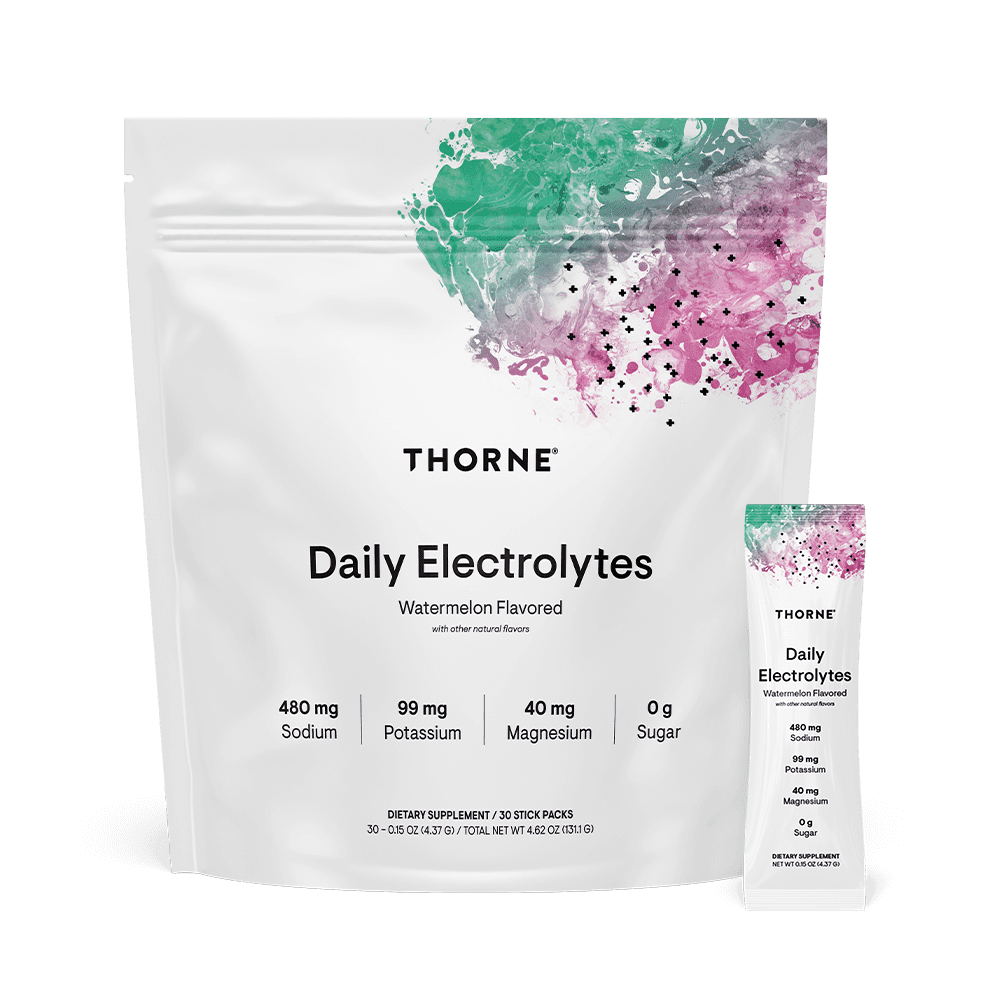
Products like LMNT and Thorne Daily Electrolytes sit at opposite ends of the sodium dosing spectrum for a reason. LMNT delivers 1,000 milligrams of sodium per packet, a dose calibrated for high output athletes and for people following ketogenic or very low carbohydrate diets, where urinary sodium excretion increases because insulin driven renal sodium retention drops. Thorne and Nuun formulas sit in the 300 to 500 milligram range, appropriate for moderate output activity or general daily use. Neither dose is universally correct. The sweat variability data from the JISSN normative study explains why both products have a legitimate use case and why the person recommending one over the other without knowing your sweat rate, your dietary pattern, and your training volume is guessing.
The glucose to sodium co transport mechanism also matters for product selection. Oral rehydration solutions designed around the SGLT1 transporter use a roughly 1 to 1 molar ratio of glucose to sodium to maximize fluid absorption in the small intestine. Many consumer electrolyte products either omit glucose entirely for caloric reasons or add it in amounts that do not reflect the absorption optimized ratio from the rehydration literature. That is not necessarily wrong, it depends on the use case, but it means the product is not maximizing intestinal fluid uptake by the mechanism the physiology supports.
Where the field still has gaps
Individual sweat sodium concentration is relatively stable within a person across sessions but varies substantially between people. A genuine precision hydration protocol would require individualized sweat patch testing before dialing in a replacement strategy. That exists at the elite sport level. It does not exist in a scalable consumer form. The normative data from professional athletes provides useful population anchors but does not tell any individual exerciser where they fall in that 20 to 80 millimole range.
The magnesium and gut barrier research is mechanistically compelling but the human trial data connecting magnesium repletion specifically to measurable improvements in gut permeability markers remains limited. The stress physiology paper used a magnesium and L theanine combination, not magnesium alone, which makes it difficult to attribute effects cleanly. And the long term question of whether consistent electrolyte optimization in a non clinical adult population produces measurable differences in cardiovascular, cognitive, or metabolic outcomes has not been answered by adequately powered prospective trials.
The sodium story is a useful reminder that the public health version of nutritional science is often a simplified version of the real one, calibrated for the population at greatest risk and stripped of the nuance that makes it accurate for everyone else.
For informational purposes only. These statements have not been evaluated by the FDA. Not intended to diagnose, treat, cure, or prevent any disease. Consult a qualified healthcare professional before starting any supplement, especially if pregnant, nursing, or taking medication.
Products Mentioned
Products from the Paragon catalog related to the topic discussed above.