GABA, Melatonin, Magnesium: Form Decides Fate
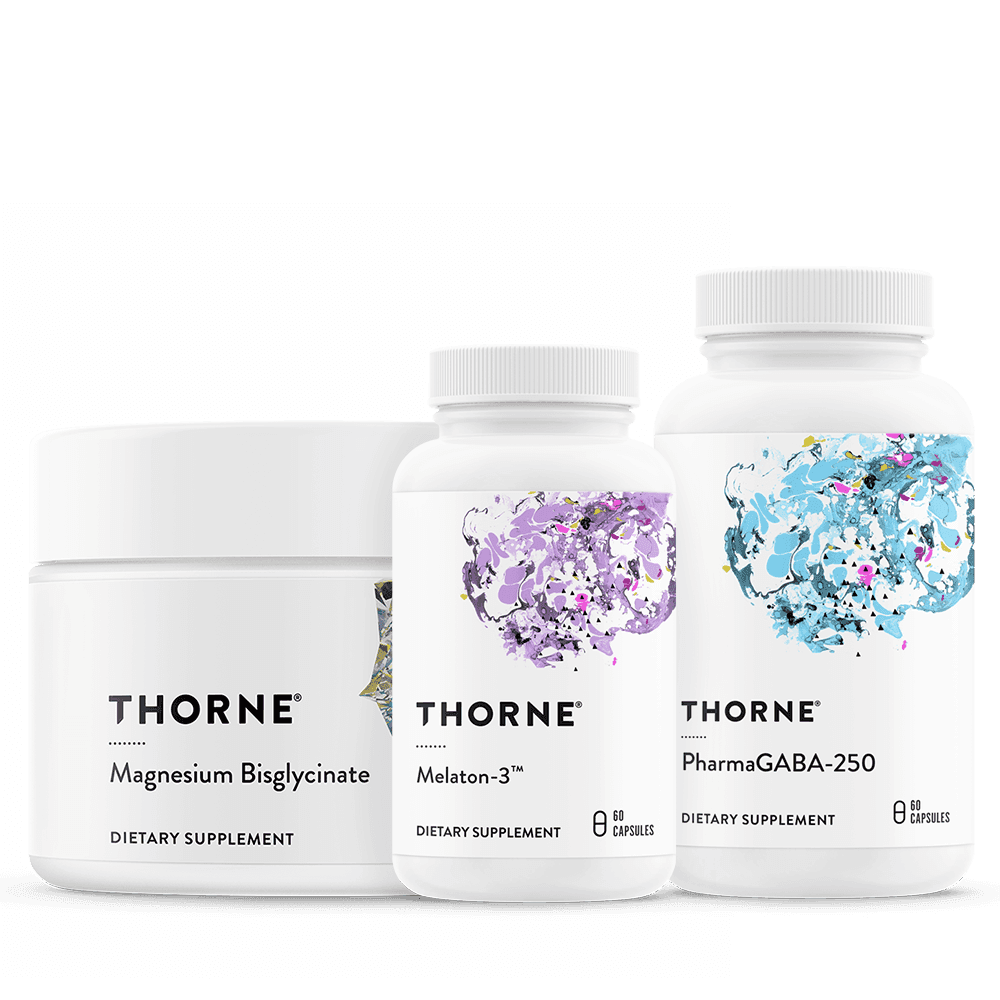
PharmaGABA at 100 to 200 mg, melatonin at 1 to 3 mg, and magnesium bisglycinate as the bioavailability leader among chelated salts. Here is what the primary literature actually measured, and why form selection is not a marketing detail.

PharmaGABA, the fermentation derived form of gamma aminobutyric acid, has published human trial data on stress response and subjective calm at doses of 100 to 200 mg per serving. Melatonin has one of the cleanest dose response curves in the sleep supplement literature, and the curve bends against you above 3 mg. Magnesium bisglycinate is the chelated salt with the strongest bioavailability data among the general purpose magnesium forms, sitting in a distinct category from the brain targeted magnesium L threonate we have written about separately. These three compounds get bundled together in evening stacks constantly. What they rarely get is a clear accounting of what the research actually measured, where the dose floors and ceilings come from, and why the specific form of each one is the variable that determines whether the trial evidence transfers to the product in your hand.
PharmaGABA: the fermentation distinction matters
GABA as a supplement has a long standing credibility problem. The core objection from neuroscience has always been that GABA is a large, charged molecule that does not readily cross the blood brain barrier, which would make an oral supplement mechanistically inert for any central nervous system endpoint. That objection is real, and it is worth taking seriously before reading any PharmaGABA trial.
What the PharmaGABA literature actually shows is something more nuanced. The controlled trials on this specific form, produced by fermenting Lactobacillus hilgardii, have not primarily argued for direct CNS penetration. Instead, they have measured peripheral markers: alpha wave activity on EEG recordings, salivary chromogranin A (a marker of sympathetic nervous system activation), and subjective stress ratings on validated scales. A crossover design comparing PharmaGABA to placebo found statistically significant reductions in chromogranin A and increases in alpha wave power at 100 mg in a human trial setting. The mechanistic interpretation that best fits that data points toward gut vagus nerve signaling. The enteric nervous system is densely populated with GABA receptors. Gut derived GABA signaling via the vagal afferent pathway is an established route through which gut activity influences the autonomic nervous system tone in the brain without requiring the molecule to cross the blood brain barrier at all. That is a meaningfully different mechanism than "GABA crosses into the brain," and it is the one the trial data actually supports.
The 100 to 200 mg dose range is the range where the published human trials operated. Below 100 mg, the literature is sparse. Above 200 mg, there is no strong evidence that additional benefit accrues, and the trials simply have not been powered to test escalation.
Melatonin: the dose ceiling the market ignores
Melatonin is one of the best documented sleep supplements in the human trial literature, and also one of the most systematically overdosed by the consumer market. The pharmacology is clear. Melatonin is a chronobiotic, a compound that shifts the phase of the circadian clock rather than acting as a sedative in the classical sense. Its primary role is in reducing sleep onset latency, the time between lying down and falling asleep, particularly when the clock signal is misaligned, as in jet lag, shift work, or delayed sleep phase patterns.
The dose response data consistently shows that 0.5 to 3 mg is the effective range for sleep onset latency reduction in human trials. The physiological melatonin concentrations that the pineal gland produces at night in healthy adults peak somewhere around 0.1 to 0.3 mg equivalent. Supplementing at 5, 10, or even 20 mg, as many commercial products deliver, produces plasma concentrations orders of magnitude above the physiological range. More is not better. Supraphysiological melatonin levels are associated with next day grogginess, suppressed endogenous production with chronic use, and potentially disrupted receptor sensitivity over time. The human trial literature on jet lag recovery specifically, which is where melatonin's evidence is among its strongest, has used doses at or below 3 mg in the best designed crossover studies. That is the dose range that produced the replicated findings. The 10 mg gummies on the pharmacy shelf were not designed around that literature.
Timing matters as much as dose. For sleep onset, melatonin taken 30 to 60 minutes before the intended sleep time in alignment with the desired circadian phase is what the trial protocols used. For jet lag specifically, timing relative to the destination time zone matters more than the dose itself.
Magnesium bisglycinate: why chelation is not just marketing
Among the general purpose magnesium salts, magnesium bisglycinate (also called magnesium glycinate) carries the strongest bioavailability argument in the peer reviewed literature. The mechanism is straightforward. In the bisglycinate form, magnesium is bound to two glycine molecules through a chelate bond. That complex is absorbed via a dipeptide transporter pathway in the small intestine that is separate from the ionic transport used by inorganic magnesium salts like oxide or sulfate. The practical consequence is that the chelated form bypasses the ion channel competition that limits absorption of inorganic forms, particularly in the presence of other minerals, food components, or antacids. Human comparative studies have documented higher fractional absorption and better gastrointestinal tolerability for chelated magnesium forms compared to oxide at matched elemental doses.
This is meaningfully different from the magnesium L threonate story. Threonate targets CNS delivery and has published human data showing brain magnesium increases specifically. Bisglycinate does not make that claim and does not need to. Its value proposition is systemic repletion: skeletal muscle, cardiac muscle, the roughly 300 enzymatic reactions that require magnesium as a cofactor, and the GABA receptor cofactor function that contributes to sleep quality through the peripheral and spinal cord pathways rather than the CNS specific mechanism threonate pursues. For an adult who wants to correct general magnesium insufficiency, which population surveys suggest is common in Western dietary patterns, bisglycinate is the form the bioavailability literature favors among the practical, affordable options.
Elemental magnesium content per dose matters here. Bisglycinate has a lower elemental magnesium percentage by weight than oxide because the glycine ligands add molecular mass. A 400 mg capsule of magnesium bisglycinate typically delivers 50 to 80 mg of elemental magnesium. Products that list "magnesium bisglycinate 400 mg" without specifying elemental content are obscuring the number that actually determines whether the dose is meaningful.
The gut microbiome thread: why these compounds do not operate in isolation
One of the underappreciated dimensions of evening supplement stacks is the gut environment through which they are absorbed and within which some of their effects originate. The PharmaGABA mechanism we described above is a gut vagus nerve mechanism. Magnesium status influences gut motility and the composition of the intestinal microbiome. Melatonin receptors are expressed in the gut as well as in the brain. These are not independent pharmacological events happening in a clean system. They are happening inside a complex microbial ecosystem whose metabolic outputs feed back into mitochondrial function, neurological signaling, and inflammatory status.
Research published in Gut Microbes examining mechanistic pathways linking gut microbial metabolites to mitochondrial function maps the routes through which microbially derived compounds including short chain fatty acids, secondary bile acids, and other co metabolites reach mitochondria and influence respiratory chain efficiency. That is not a supplement paper. It is a systems biology paper. But its relevance here is concrete: the gut environment through which magnesium bisglycinate is absorbed, and within which PharmaGABA's vagal signaling originates, is the same environment whose microbial outputs are feeding into the cellular energy production machinery that governs how rested a person actually feels after sleep. Magnesium's role in gut barrier integrity means that maintaining adequate status is upstream of the microbial ecosystem health that the Gut Microbes paper's mechanistic pathways depend on.
The boundary phase insight: what condensed matter physics reveals about receptor state transitions
One of the more precise conceptual frames for understanding how these compounds interact with receptor systems comes from an unexpected direction. A condensed matter physics paper on boundary phases and quantum phase transitions in the Kondo spin chain model studies what happens when an impurity coupled to the boundary of a strongly correlated system drives a sequence of phase transitions, reorganizing the available energy states into distinct configurations depending on coupling strength. The key insight is that boundary coupling, the interaction at the interface between two systems, does not produce gradual change. It produces sharp transitions between qualitatively different states, each with its own emergent properties, as the coupling parameter crosses a threshold.
That framework maps onto GABAergic receptor pharmacology with more precision than the analogy might initially suggest. The GABA type A receptor does not respond to ligands on a smooth linear scale. It transitions between distinct functional states: resting, open, and desensitized, in response to the concentration and character of bound ligands at different binding sites. PharmaGABA operating through the peripheral gut vagal route, melatonin acting on MT1 and MT2 receptors in the suprachiasmatic nucleus, and magnesium acting as a cofactor at GABA receptors and as an antagonist at NMDA receptors are all boundary interactions in this sense. Each one perturbs a receptor system at an interface and drives it toward a qualitatively different state. The physics paper's language of boundary bound states and tower restructuring is a precise description of what allosteric modulation at receptor complexes actually produces: reorganized functional states, not scaled versions of the baseline state. That is why dose thresholds in this literature are real and why exceeding them does not simply produce more of the same effect.
The social environment problem that no supplement addresses
We want to name something that the evening stack conversation consistently underweights. A STAT News opinion on the shared structural flaw in US and UK healthcare systems, written by Kyle Vanelli, argues that clinical systems have become absorbers of social problems, metabolizing loneliness, isolation, and community loss as if they were biomedical conditions amenable to biomedical responses. The piece makes the case that the costs of treating downstream physiological consequences of upstream social deficits are now substantial and growing, while the prevention investment remains inadequate.
That argument lands directly in the stress response and sleep quality space. Chronic social isolation is among the most robustly documented upstream drivers of elevated cortisol, disrupted sleep architecture, and autonomic nervous system dysregulation. PharmaGABA at 200 mg operates on a neuroendocrine system that, in many of the people reaching for it, is under load from conditions that no supplement addresses. We say this not to undermine the compound's trial evidence, which is real, but to be honest about what the evidence base was built on. The PharmaGABA trials measured acute stress response in controlled settings. They did not measure long term effects in people experiencing chronic social stressors. That distinction matters for setting realistic expectations about what the supplement can and cannot do.
What a total solar eclipse teaches about perception thresholds
There is a useful phenomenological point embedded in an unlikely place. Nautilus coverage of this year's solar eclipse photography captures something that eclipse observers consistently report: the transition from 99 percent totality to 100 percent is not a 1 percent increment. It is a categorical shift. The corona becomes visible. Stars appear. Temperature drops. The visual and sensory environment transforms discontinuously at the threshold of complete occlusion. One percent of remaining sunlight is not experientially equivalent to one percent of the full experience. The system crosses a threshold and enters a qualitatively different state.
The melatonin dose response curve works the same way. The transition from subthreshold melatonin receptor occupancy to threshold occupancy that shifts circadian phase is not a smooth ramp. There is a functional threshold below which receptor activation is insufficient to reset the clock and above which it is. That threshold sits well below 3 mg for most adults, which is why escalating to 5 or 10 mg does not add proportional benefit. It is pharmacologically analogous to adding more moonlight after totality. The relevant threshold has already been crossed. What lies above it is supraphysiological receptor exposure without additional chronobiotic effect, and with the next day grogginess that comes from prolonged, excessive receptor occupancy.
Iron, oxidative stress, and the night shift: a metabolic context note
One of the physiological processes that adequate sleep supports is cellular redox management, the ongoing balance between oxidative stress production and antioxidant defense. That connection is not incidental. Sleep is a period of reduced metabolic demand during which antioxidant systems can outpace reactive oxygen species production and tissue repair processes can run without competition from active metabolism. A Fight Aging analysis of iron metabolism and ferroptosis in the context of atherosclerosis describes how disturbances in iron homeostasis feed into oxidative stress cascades that can overwhelm cellular antioxidant defenses and trigger a form of regulated cell death called ferroptosis. While that analysis focuses on cardiovascular tissue, the underlying mechanism, iron dysregulation driving reactive oxygen species accumulation that outpaces cellular defense capacity, is a systemic one.
Magnesium has an indirect but real connection to this picture. Magnesium is required for the activity of glutathione synthetase, one of the enzymatic steps in producing glutathione, the cell's primary intracellular antioxidant. Insufficient magnesium compromises glutathione production capacity. In the context of oxidative stress management during sleep, where the window for antioxidant work is the very window that melatonin and GABA tone are supposed to protect, magnesium status is upstream of the cellular machinery doing the repair work. This is not a disease claim. It is a mechanistic observation about cofactor requirements, and it is one reason we think the three compounds in an evening stack have more functional interdependence than the single ingredient trial literature captures.
What the dose architecture actually asks of you
Putting the trial evidence together, the practical picture looks like this. PharmaGABA at 100 to 200 mg, taken 30 to 60 minutes before the intended sleep time, addresses autonomic nervous system tone through a gut vagal pathway that the human trial literature has measured in controlled crossover designs. Melatonin at 0.5 to 3 mg, timed to align with the desired circadian phase, addresses sleep onset latency through a receptor mechanism that is saturated well below the doses most commercial products deliver. Magnesium bisglycinate at a dose that delivers 200 to 400 mg of elemental magnesium daily supports the enzymatic and receptor cofactor functions that both GABA signaling and cellular antioxidant defense depend on.
None of those three compounds are substitutes for the upstream variables that govern sleep quality and stress response at a population level. What the trial literature supports is a pharmacologically coherent set of interventions operating on distinct but mechanistically connected targets, at doses where the evidence was actually generated, in forms where the delivery chemistry can be defended. Form is not decoration. The fermentation process behind PharmaGABA matters. The 1 to 3 mg ceiling on melatonin matters. The chelation chemistry behind bisglycinate matters. Those are the variables that determine whether the research transfers from the paper to the person.
The question the field still owes an answer to is a proper multi arm combination trial testing PharmaGABA, low dose melatonin, and magnesium bisglycinate together against each ingredient alone and against placebo, using polysomnography as the primary endpoint and cortisol awakening response as a secondary one. The individual ingredient literatures are real. The combination logic is mechanistically coherent. The trial that would settle whether the three together produce effects that exceed any single ingredient has not been run.
For informational purposes only. These statements have not been evaluated by the FDA. Not intended to diagnose, treat, cure, or prevent any disease. Consult a qualified healthcare professional before starting any supplement, especially if pregnant, nursing, or taking medication.
Products Mentioned
Products from the Paragon catalog related to the topic discussed above.