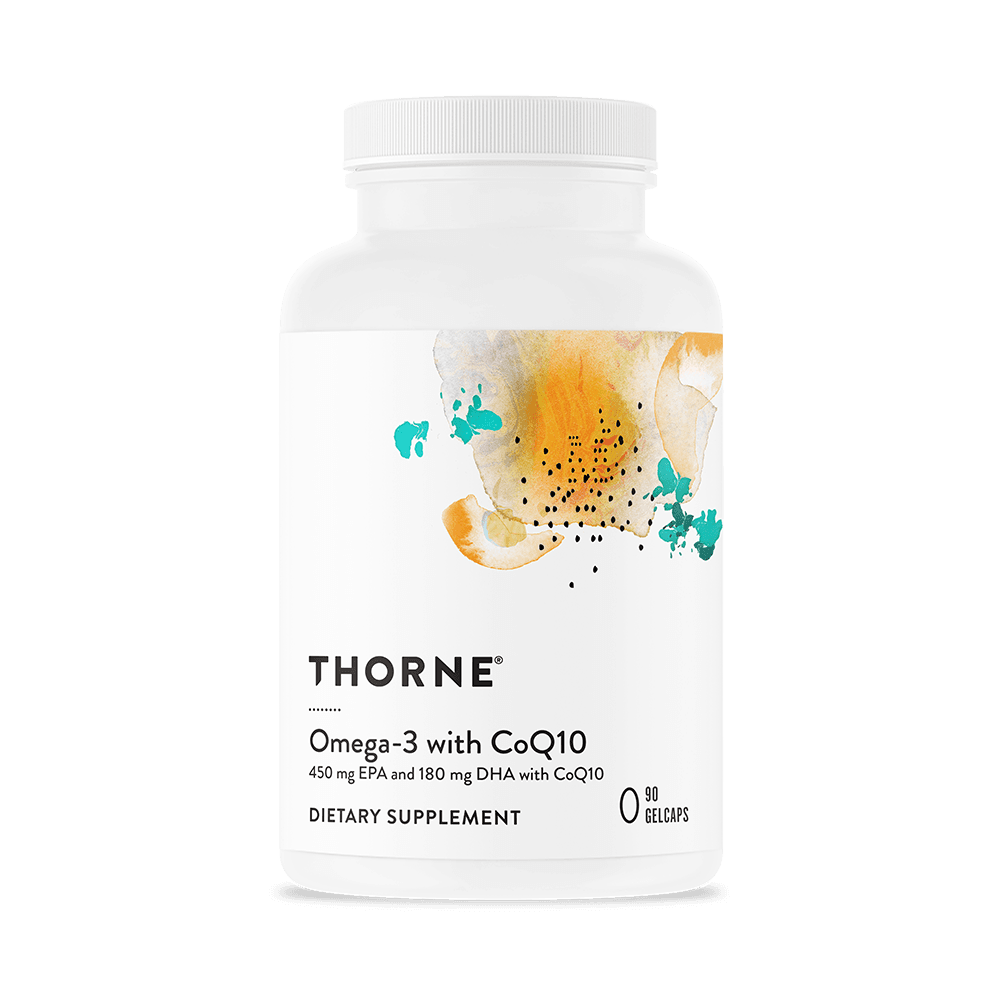
CoQ10 and Omega 3: What the Trials Measured
EPA and DHA doses in the cardiovascular trial range, CoQ10's role in mitochondrial ATP production, and what statin therapy does to endogenous synthesis. Here is what the primary literature actually measured.

CoQ10 sits in the inner mitochondrial membrane as a mobile electron carrier, shuttling electrons from complexes We and II to complex III in the respiratory chain. Without it, the proton gradient that drives ATP synthase does not form properly. That is not a fringe claim. It is textbook bioenergetics. What makes CoQ10 interesting as a supplement topic is not the mechanism, which has been known for decades, but the specific circumstances under which endogenous synthesis becomes inadequate: aging and statin therapy. Those two conditions, often present simultaneously in the same person, are where the supplementation literature finds its clearest signal.
The dose range the cardiovascular trials actually used
EPA and DHA, the two long chain omega 3 fatty acids from marine sources, have been studied at a wide range of doses for cardiovascular endpoints. The trials with the most discussed outcomes cluster around 1 to 2 grams of combined EPA and DHA per day. REDUCE IT, which used 4 grams of icosapentaenoic acid daily as a pharmaceutical preparation, sits above that range and generated separate controversy about its mineral oil placebo. The 1 to 2 gram range is where consumer grade fish oil sits, and the trial literature at that dose has measured outcomes including triglyceride levels, platelet aggregation markers, and inflammatory indices. The mechanism connecting long chain omega 3s to those endpoints runs through their incorporation into cell membrane phospholipids, where they alter membrane fluidity and compete with arachidonic acid as substrates for the inflammatory eicosanoid cascade. That competition is the relevant biology for understanding why the dose matters and why the form of the fatty acid, ethyl ester versus triglyceride versus phospholipid, affects bioavailability and, by extension, how much of a given dose actually reaches target tissues.
What statin therapy does to CoQ10 synthesis
Statins inhibit HMG CoA reductase, the rate limiting enzyme in the mevalonate pathway. The mevalonate pathway is also the upstream route for CoQ10 biosynthesis, because the isoprenoid side chain that gives CoQ10 its membrane anchoring tail is derived from mevalonate intermediates. Blocking HMG CoA reductase therefore reduces not just cholesterol synthesis but also endogenous CoQ10 production. The magnitude of that reduction in humans is variable and has been contested in the literature, but multiple controlled studies have documented lower plasma CoQ10 concentrations in patients on statin therapy compared to controls. Plasma CoQ10 is an imperfect surrogate for tissue CoQ10 status, because CoQ10 is predominantly intracellular and especially concentrated in mitochondria rich tissues like cardiac and skeletal muscle. The measurement problem complicates interpretation. What the literature does support clearly is that the enzymatic pathway driving endogenous CoQ10 synthesis is the same pathway statins pharmacologically suppress.
Aging compounds the picture independently of statin use. Endogenous CoQ10 synthesis declines with age through mechanisms that include reduced expression of the enzymes involved in the biosynthetic pathway, and the mitochondrial density of tissues that most depend on CoQ10, including heart muscle, also changes with age. An older adult on a statin is therefore facing a double reduction in CoQ10 availability: one from the drug and one from the biology of aging.
What controlled trials on CoQ10 supplementation have measured
The human trial literature on CoQ10 supplementation covers several outcome categories with uneven levels of evidence across them. Statin associated muscle symptoms, which affect somewhere between 5 and 25 percent of statin users depending on the trial and the definition used, have been the subject of multiple randomized controlled trials on CoQ10 supplementation. Results are mixed. Some trials report reduced muscle symptom scores in participants receiving CoQ10 compared to placebo. Others find no significant difference. Meta analyses of available trials have generally concluded that the evidence is suggestive but not definitive, with heterogeneity in dose, CoQ10 form, and patient population making pooled interpretation difficult. That is an honest read of where the muscle symptom literature sits rather than either dismissing or overstating the signal.
Exercise tolerance as an endpoint has been studied in older adults and in patients with heart failure, where mitochondrial dysfunction is part of the pathophysiology. The Q SYMBIO trial, a randomized controlled study in chronic heart failure patients, reported statistically significant reductions in major adverse cardiovascular events and improved functional capacity in the CoQ10 group compared to placebo at 300 mg per day over two years. That is a human trial finding with a hard endpoint, not a surrogate marker. It is also a heart failure population, not a healthy adult population, which means the magnitude of effect observed there does not transfer directly to a healthy adult taking CoQ10 preventively. The distinction matters when evaluating what the trial literature actually showed and for whom.
Ubiquinol versus ubiquinone: the form debate
CoQ10 exists in two forms: ubiquinone (the oxidized form) and ubiquinol (the reduced, active form). In healthy younger adults, the body converts ubiquinone to ubiquinol efficiently. In older adults, that conversion appears less efficient, which is the mechanistic rationale for ubiquinol supplementation specifically. Human pharmacokinetic comparisons have shown higher plasma CoQ10 concentrations from ubiquinol at matched doses in older populations, suggesting that the conversion step is indeed a meaningful variable in the dose response relationship. Whether that pharmacokinetic advantage translates to meaningfully different clinical outcomes has not been settled in adequately powered head to head trials with hard endpoints. For practical purposes, ubiquinol represents the more bioavailable form, particularly in adults over 50, and the Q SYMBIO trial used ubiquinone, which means its findings cannot be directly used to argue for one form over the other.
The microactuator angle: what bioinspired materials reveal about mitochondrial design
One of the more unexpected perspectives on mitochondrial engineering comes from soft materials physics. a preprint on bioinspired microactuators fabricated by meniscus guided 3D nanoprinting describes a composite architecture that integrates a rigid nanoparticle scaffold with a hygroscopic polymer matrix in a single structure, directly inspired by insect exoskeletal joints. The key design principle is functional integration of rigid and compliant components: the rigid scaffold provides mechanical support while the polymer phase drives humidity responsive actuation. Neither element alone produces the behavior. The combination does.
That architecture is a useful conceptual frame for understanding the inner mitochondrial membrane. CoQ10 operates specifically in the membrane's lipid phase, where its mobility as a carrier depends on the fluidity of the phospholipid bilayer. EPA and DHA incorporated into that membrane change its physical properties, increasing fluidity and reducing the activation energy for CoQ10 diffusion between respiratory chain complexes. The two compounds are working in the same physical compartment through complementary mechanisms: CoQ10 as the mobile electron carrier, omega 3 fatty acids as the structural modifiers of the medium through which it moves. The rigid and compliant component logic from the nanoprinting paper maps onto this system with more precision than the analogy might initially suggest. Membrane biophysics is an engineering problem, and the two compounds address different physical constraints within it.
Polyamine metabolism and cellular maintenance: what the longevity literature adds
One of the more interesting adjacent findings in the longevity biology space concerns how cells regulate their own maintenance and repair machinery under stress. a 2025 paper in Renal Failure examining AMD1 mediated polyamine metabolism in tubular repair after kidney injury found that polyamine synthesis, governed by the enzyme AMD1, plays a regulatory role in whether injured tubular cells enter senescence or successfully repair. Specifically, the paper found that spermidine, a polyamine that is also a known inducer of autophagy, was central to restraining the senescence fate in injured cells. Autophagy is the cellular recycling process that clears damaged organelles, including dysfunctional mitochondria, through a process called mitophagy.
The connection to CoQ10 biology is not direct but it is mechanistically adjacent in an important way. Mitochondrial quality control depends on the same autophagic machinery that the polyamine research is probing. When CoQ10 availability falls and mitochondrial function is compromised, cells rely on mitophagy to clear dysfunctional mitochondria before they generate excess reactive oxygen species. That clearance process is upstream of whether a cell maintains function or enters senescence. The renal failure paper's finding that polyamine metabolism governs this fate decision in one tissue type raises the question of whether the same regulatory logic applies in cardiac and skeletal muscle, tissues where CoQ10 insufficiency is most clinically relevant. It also suggests that the full picture of mitochondrial health in aging tissue is not just about substrate availability for the respiratory chain. It includes the cellular machinery that decides what to do with mitochondria that are no longer functioning well.
What the culture of rigid protocols gets wrong: a parallel from addiction medicine
There is an instructive parallel between the history of rigid dosing protocols in medicine and how supplement recommendations have been communicated to the public. STAT News reporting on how methadone clinics are navigating a rules overhaul documents the slow cultural shift away from one size fits all dispensing protocols toward individualized, flexible approaches to care. The insight embedded in that reporting is that rigid protocols, even when they emerge from legitimate regulatory concern, can obscure meaningful individual variation in what patients actually need. The rules were built for population level risk management. The individual sits outside the average.
CoQ10 supplementation research has a version of this problem. The mixed results across statin associated muscle symptom trials partly reflect patient level heterogeneity that population averaged trial designs cannot resolve: some people on statins have meaningfully depleted muscle CoQ10, others do not, and the supplement benefit in the trial average gets diluted by participants who did not have the deficit to begin with. Dosing in those trials has also varied from 100 mg to 600 mg per day, with form varying between ubiquinone and ubiquinol, making pooled inference difficult. The honest read is that the literature has not yet been designed to identify which patients, at which dose, over what duration, see a meaningful signal. That is the experiment the field still owes.
Adaptive tool use and the cognition of supplementation decisions
There is something worth naming about how intelligent systems, whether biological or human, decide to use external resources to extend their capabilities. Nautilus reporting on a dolphin filmed using a shell as a hunting tool to trap and capture fish documents a behavior that depends on recognizing when internal capability alone is insufficient and an external resource changes the outcome. Tool use in animals is understood as an indicator of cognitive flexibility: the capacity to recognize a gap between current capability and required outcome, and to identify and deploy a resource that closes it.
That framing maps onto supplementation decisions in a way that is not merely rhetorical. CoQ10 supplementation is rational specifically in contexts where endogenous synthesis is compromised. The aging adult on a statin is recognizing, or should be recognizing, that their internal biosynthetic capacity for CoQ10 has been reduced by a pharmacological intervention, and that an exogenous source can partially restore what the drug removed. That is not analogous to taking CoQ10 because it sounds beneficial. It is a gap closure decision, like the dolphin's shell, made because the internal resource has been specifically depleted.
The renovation of familiar environments: why landmark structures are not what they were
There is a quieter observation worth making about how deeply familiar things get transformed by external pressure over time without announcing the transformation. Azania Imtiaz Patel's essay in Aeon about her pilgrimage to Mecca describes arriving at one of the most written about places in the world and finding that the physical landscape has been so substantially altered by modernization that almost nothing she expected to see was there. The sacred geography had been replaced by infrastructure. The experience she anticipated, shaped by centuries of description, did not match the experience she had.
The CoQ10 literature has a version of this. The compound that practitioners learned about in graduate school, studied primarily in heart failure and mitochondrial disease contexts, has accumulated a substantially larger evidence base in aging, statin use, and exercise tolerance over the past two decades. The conceptual landscape has shifted considerably. But the practitioner who learned about CoQ10 in a specific clinical context and has not revisited the literature is navigating the new map with an old one. The Q SYMBIO findings, the ubiquinol bioavailability pharmacokinetics, and the emerging connections between mitochondrial quality control and autophagic clearance are features of the current landscape that were not there when the original understanding was formed. The compound name is the same. The evidence base around it has been substantially rebuilt.
Dose, timing, and what the trials actually used
The omega 3 trial literature at 1 to 2 grams of combined EPA and DHA per day has measured triglyceride reduction consistently, with a rough dose response of roughly 5 to 10 percent reduction per gram of combined EPA plus DHA at that range in human trials. The anti inflammatory marker data at those doses is more variable across trials. Timing relative to meals matters for absorption: omega 3 fatty acids in triglyceride form (rTG) absorb more efficiently with dietary fat present, which is why the standard recommendation is to take fish oil with the largest meal of the day.
CoQ10 is fat soluble and absorbs best with a fat containing meal as well. The dose range used across the human trial literature is wide: 100 to 300 mg per day in most statin symptom and exercise tolerance trials, and up to 300 mg per day in Q SYMBIO. Softgel formulations with oil based carriers generally outperform dry powder capsules in pharmacokinetic comparisons. Ubiquinol formulations require particular attention to oxidation stability, because ubiquinol can revert to ubiquinone under heat and light exposure, which is why storage conditions matter in a way they do not for most water soluble supplements.
Where the evidence sits and what it does not yet resolve
The case for omega 3s at cardiovascular trial doses is the most straightforward part of this conversation. The EPA and DHA trial literature at 1 to 2 grams per day is large, reasonably consistent on triglyceride endpoints, and sufficiently replicated to take seriously. The case for CoQ10 supplementation is most coherent in two specific populations: adults on statin therapy where endogenous synthesis has been pharmacologically reduced, and older adults facing the compound reduction from aging plus any concurrent statin use. In healthy adults with neither of those circumstances, the CoQ10 evidence base is thinner because the baseline deficit is less well established.
What the field still owes is a well powered randomized controlled trial in statin users specifically, using ubiquinol at doses of 200 to 300 mg per day, with both plasma CoQ10 confirmation and validated muscle symptom endpoints, run long enough to capture the time course of any benefit. The existing trials are too heterogeneous in dose, form, and patient selection to give that answer clearly. That trial has the design to settle the statin associated muscle symptom question. It has not been run at sufficient scale.
For informational purposes only. These statements have not been evaluated by the FDA. Not intended to diagnose, treat, cure, or prevent any disease. Consult a qualified healthcare professional before starting any supplement, especially if pregnant, nursing, or taking medication.
Products Mentioned
Products from the Paragon catalog related to the topic discussed above.