Magtein, Apigenin, Theanine: The Stack Examined
Magnesium threonate, apigenin, and L theanine each carry independent trial literature. Here is what the primary studies actually measured, and why the combination became the sleep stack everyone is talking about.

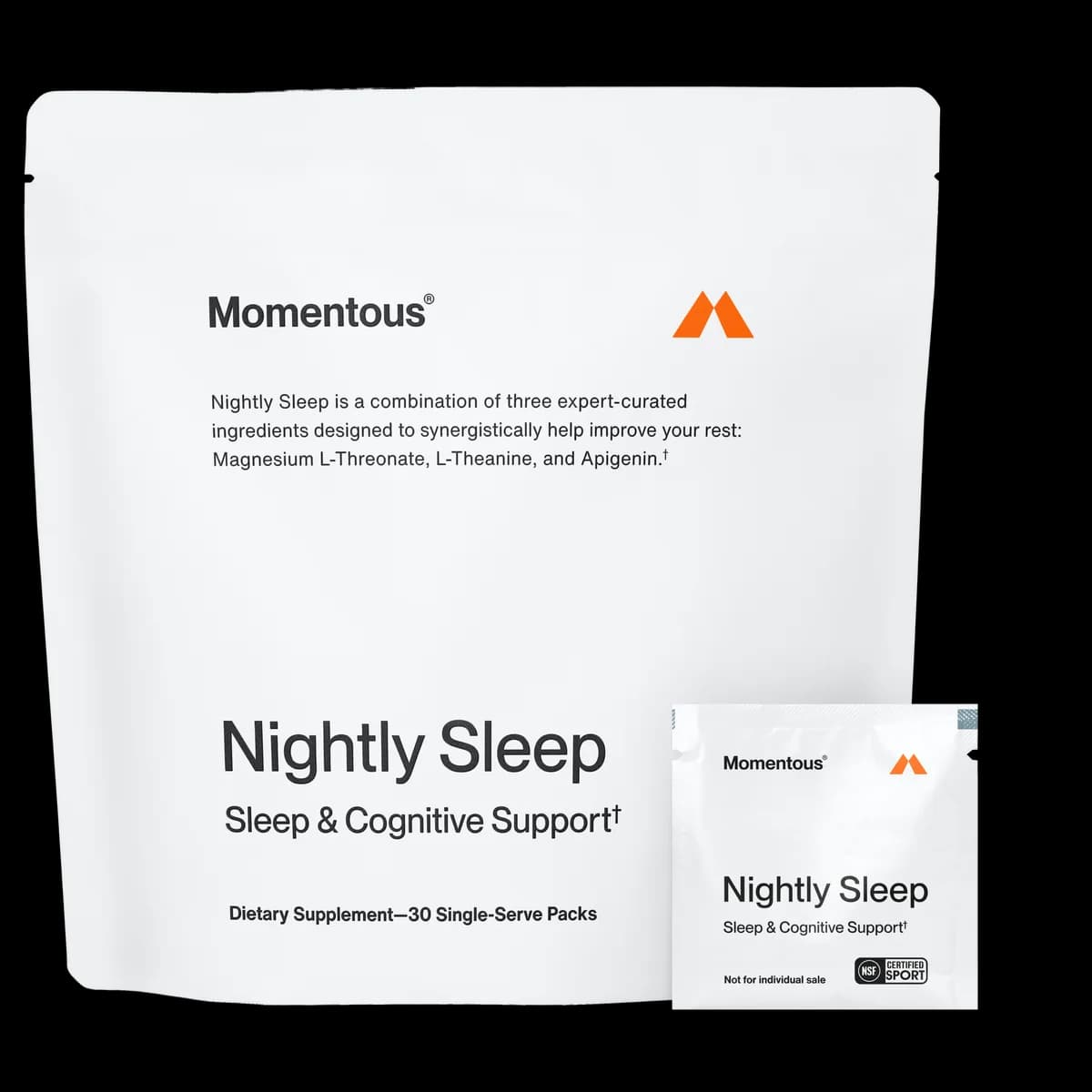
Magnesium threonate at 2 grams per day, apigenin at 50 mg, L theanine at 100 to 200 mg. That stack has circulated widely enough that it no longer needs a celebrity endorsement to show up in a supplement buyer's cart. What it does still need is an honest accounting of what the underlying trials actually measured, where the evidence is solid, and where the combination logic is being asked to carry more weight than any individual ingredient's literature fully supports.
What Magtein's 2 gram dose was built to do
The 2 gram daily dose of Magtein (magnesium threonate) is not an arbitrary round number. It comes directly from the trial architecture developed from MIT research, where that dose delivered roughly 144 milligrams of elemental magnesium while demonstrating measurable effects on brain magnesium specifically. That last phrase is the key one. Magnesium glycinate, citrate, and malate all raise circulating magnesium. The threonate form was developed precisely because the threonate anion appears to facilitate transport across the blood brain barrier into the CNS compartment, where magnesium functions as a GABA receptor cofactor and as an NMDA receptor antagonist. Both receptor pathways are directly involved in sleep architecture and in synaptic plasticity underlying working memory.
The human trial data at that dose measured sleep quality, working memory, and executive function in older adults using validated cognitive batteries and sleep quality indices, not self report impressions alone. The signal across those endpoints was consistent in the treatment group compared to placebo. We covered that trial architecture in detail in an earlier piece. What is worth adding here is how the Magtein data fits within the broader picture of why the three ingredient stack makes mechanistic sense when you look at what each compound is targeting and at which receptor level.
Apigenin: from chamomile extract to targeted receptor pharmacology
Apigenin is a flavone found at meaningful concentrations in chamomile, parsley, celery, and a few other botanical sources. Chamomile extract trials on sleep quality have been running since the early 2000s, measuring outcomes like sleep latency, nighttime awakening frequency, and validated sleep quality scores. Those trials are generally positive and modest in effect size, which is exactly what you would expect from a flavone acting on GABA receptors at the concentrations achievable from a standardized herbal extract.
The mechanism is worth being precise about. Apigenin is a partial agonist at the benzodiazepine binding site on the GABA type A receptor. It does not produce the sedative ceiling or dependency profile of pharmaceutical benzodiazepines because it binds with lower affinity and does not fully activate the receptor. That partial agonism is precisely what makes it interesting as a supplement ingredient: it modulates GABAergic tone in a direction that supports sleep onset and reduces anxious arousal without the CNS depression that characterizes the prescription drug class.
More targeted research has examined apigenin separately for anxiety related outcomes, where the same GABA receptor mechanism is the operative one. The literature in this space is thinner than the chamomile sleep trial literature and much of the mechanistic depth comes from in vitro receptor binding assays and animal model behavioral work rather than large human RCTs. That distinction matters and is worth keeping front of mind when evaluating what the apigenin literature can actually tell you about expected effects at 50 mg per day in a human adult.
L theanine: the cleanest human trial record of the three
L theanine at 100 to 200 mg has, arguably, the most replicable and cleanest human trial record of the three ingredients in this stack. The sleep quality literature on theanine covers multiple randomized controlled trials using validated endpoints including the Pittsburgh Sleep Quality Index, actigraphy, and polysomnography in some designs. Consistent findings include improvements in sleep efficiency, reductions in nighttime awakening, and reductions in subjective sleep latency. Effects appear dose dependent within the 100 to 400 mg range studied, with 200 mg being the most commonly used dose in the sleep focused trials.
The stress response endpoint literature adds a separate mechanistic layer. Theanine raises alpha wave activity in EEG recordings, a brain state associated with relaxed alertness rather than sedation. That profile distinguishes it pharmacologically from both benzodiazepines and from classical sedatives. It also explains why theanine pairs well with caffeine in the focus and alertness literature, where the combination attenuates caffeine's anxiogenic side effects without blunting its cognitive stimulant properties. For the sleep stack context, the relevant theanine mechanism is the evening counterpart to that same profile: it supports parasympathetic tone and attenuates the hyperarousal that delays sleep onset in people under chronic stress load.
The stress response trials on theanine measured cortisol and salivary alpha amylase as objective markers alongside subjective anxiety scales. The human trial signal on attenuated physiological stress markers is real, if modest in effect size, and has been replicated across independent research groups.
Why the combination became the stack
The three ingredient combination gained traction not because a single industry sponsored trial tested it as a formulation but because the individual ingredient literatures point toward three partially overlapping and partially complementary receptor mechanisms. Magtein works through CNS magnesium repletion affecting both GABA and NMDA receptor function. Apigenin works through partial agonism at the benzodiazepine site on GABA type A receptors. Theanine works through alpha wave modulation, NMDA receptor partial antagonism, and attenuation of the noradrenergic stress axis. None of those mechanisms is identical. None is redundant with the others. The three together address the sleep onset and sleep quality problem from angles that a single compound approach cannot fully cover.
The honest caveat is that the combination as a specific formulation has not been tested in a head to head randomized controlled trial against each ingredient alone and against placebo simultaneously. That four arm design would be what you would want to confirm additive or synergistic effects versus what might be an additive story told by independent literatures. The mechanistic rationale for the stack is coherent. The direct combination trial that would clinch it has not been published.
The receptor window problem: why timing and dose matter differently for each ingredient
The dose timing logic for each ingredient reflects different pharmacokinetic profiles. Theanine reaches peak plasma concentration within roughly 30 to 60 minutes of oral ingestion, which is why the sleep trial protocols typically use it 30 to 60 minutes before intended sleep time. Apigenin has a slower tissue distribution profile and is often taken earlier in the evening. Magtein trials typically split the dose, with a smaller fraction taken earlier in the day and the larger fraction in the evening, reflecting the sleep quality endpoint emphasis and the likely contribution of elevated brain magnesium to GABAergic and NMDAergic tone during the sleep window.
Getting those timing windows right is not a trivial detail. It is the difference between a protocol that reproduces the conditions of the individual ingredient trials and one that uses the right ingredients at the wrong time and attributes weak results to the compounds rather than to the protocol. This is a point the individual trial designs make implicitly: the dose and timing were not arbitrary, they were the result of iterative research.
The receptor targeting problem: a lesson from psychedelic neuropharmacology
The most useful cross disciplinary angle on this stack comes from an unexpected direction. Nautilus reporting on new brain imaging research into mescaline describes how first generation brain scans of a classical psychedelic suggest it travels a different receptor pathway than structurally similar compounds in its class. The implication is that two compounds engaging overlapping receptor families can produce meaningfully different downstream effects depending on which receptor subtypes they preferentially engage, at what affinity, and in what brain regions. That finding from psychedelic neuropharmacology is directly applicable to interpreting the sleep stack literature. Apigenin and pharmaceutical benzodiazepines both hit GABA type A receptors, but the receptor subtype selectivity, binding affinity, and downstream effects differ enough to make them functionally distinct. Theanine and magnesium both engage NMDA receptor function, but through different mechanisms and at different receptor sites. The lesson from receptor pharmacology broadly, whether the compound in question is mescaline or a flavone, is that knowing a compound engages a receptor family tells you less than knowing which subtype, at what affinity, and with what downstream signaling consequences.
Brain aging clocks and why sleep quality endpoints matter beyond the night
There is a longer time horizon argument for this stack that the sleep quality framing undersells. The sleep quality endpoint in the Magtein and theanine trials is not just about feeling rested the next morning. Sleep architecture, specifically slow wave sleep and the glymphatic clearance that accompanies it, is increasingly understood as a primary driver of brain aging trajectory. A review of the current state of brain specific aging clocks at Fight Aging summarizes where the field stands on measuring biological brain age separately from whole body aging. The key finding is that brain tissue can age at a meaningfully different rate than other organs, and that measuring that divergence requires brain specific biological clocks rather than the body wide mortality risk clocks that dominate the current aging biomarker literature.
Sleep disruption is among the most consistently cited upstream drivers of accelerated brain aging in that review's framing. What that means for interpreting the Magtein and theanine trial endpoints is that a 14 minute reduction in sleep latency or a measurable improvement in sleep efficiency is not a cosmetic outcome. It is a variable that the emerging brain aging clock literature treats as mechanistically upstream of the long term cognitive trajectory that the field most wants to protect. The connection between nightly sleep quality and decadal brain aging is the reason that sleep stack research, even when its short term effect sizes look modest, is worth taking seriously in a longevity biology frame.
Surveillance, self tracking, and the data ownership question
The broader context in which sleep stack consumers are operating is worth naming. A growing number of people tracking this stack are doing so alongside wearable sleep monitoring, continuous glucose monitors, and other biometric tools that generate shareable personal health data. A STAT News opinion on how health insurers and certain wellness policy frameworks treat bodies like cars to be surveilled raises a structural caution that health conscious adults using these tools should think through. The self tracking impulse that leads someone to optimize their sleep stack with Magtein and theanine is the same impulse that generates the detailed personal health data that insurers and third parties have a growing financial interest in accessing. Using a wearable to confirm that the stack is improving your sleep efficiency is a reasonable personal experiment. Being aware of where that data goes and who prices risk based on it is a different question, and one the supplement optimization community has not fully grappled with.
Carnosine as a contrast case: what a rigorous dose escalation trial looks like
It is useful to hold the sleep stack ingredient literature up against what a more classical sports nutrition intervention trial looks like in methodological terms. A placebo controlled randomized clinical trial on carnosine supplementation and physical endurance published in the Journal of the International Society of Sports Nutrition illustrates the kind of dose escalation and placebo controlled design that produces the clearest human trial signal in a supplement context. That trial structure, standardized dose, randomization, placebo arm, validated endpoints, is the benchmark against which the sleep stack ingredient literature should be honestly compared. The Magtein and theanine human trials meet that benchmark reasonably well for their primary endpoints. The apigenin literature, particularly for the more targeted anxiety related endpoints beyond the chamomile extract sleep trials, is thinner by that standard. That asymmetry is worth knowing rather than flattening.
The recoverability framing: what quantum information theory contributes to thinking about sleep
The most counterintuitive conceptual bridge in this area comes from theoretical physics. A paper on finite window recoverability in local quantum memory systems introduces a framework for distinguishing between information that has been lost from a target site and information that has merely migrated into nearby degrees of freedom where it remains recoverable through bounded local operations. The central insight is that apparent loss and genuine loss are categorically different, and that the recoverable fraction depends critically on the depth and locality of the control operations you can bring to bear.
That framework maps onto sleep biology in a way that is not merely metaphorical. During sleep, synaptic downscaling, glymphatic waste clearance, and memory consolidation processes all depend on the brain's ability to access and reorganize information encoded during waking hours. When sleep architecture is disrupted, the failure is not simply one of rest. It is a failure of the recovery operations that make encoded neural information accessible to subsequent cognitive processing. The magnesium and theanine mechanisms that support slow wave sleep and reduce nighttime awakening are, in this framing, interventions that increase the window within which those recovery operations can complete. The physics paper's language of finite window recoverability and bounded local control is a precise description of what adequate sleep architecture actually enables at the neural systems level. That the framework was developed for quantum error correction and not for sleep neuroscience does not make the analogy less exact.
Where the evidence sits and what the combination trial still owes
Each of the three ingredients carries a genuine and independent literature. L theanine has the broadest and most replicable human RCT record for sleep quality and stress response endpoints. Magtein has the most mechanistically differentiated story, with CNS specific delivery data that no other magnesium form has matched in human trials. Apigenin's human trial record is real but thinner, concentrated in the chamomile extract sleep literature and in receptor binding work that mostly runs through animal models and in vitro assays for the more targeted anxiety adjacent endpoints.
The combination's popularity is running ahead of direct combination trial evidence, which is the honest read on where things stand in 2026. The mechanistic logic for the stack is coherent. The individual ingredient literatures are real. The trial that would settle the combination question with a properly powered four arm design has not been published. That is not a reason to dismiss the stack. It is a reason to hold the individual ingredient evidence clearly in mind rather than letting the combination's popularity substitute for trial evidence that does not yet exist.
The next paper worth looking for in this literature is a randomized controlled trial comparing the three ingredient combination against each ingredient alone and against placebo, using polysomnography as the primary sleep endpoint and validated cognitive batteries as secondary endpoints, in adults across a range of ages and baseline sleep quality scores. That design would tell us whether the combination produces effects that exceed what any single ingredient achieves on its own, and in which populations the combination effect is largest.
For informational purposes only. These statements have not been evaluated by the FDA. Not intended to diagnose, treat, cure, or prevent any disease. Consult a qualified healthcare professional before starting any supplement, especially if pregnant, nursing, or taking medication.
Products Mentioned
Products from the Paragon catalog related to the topic discussed above.